

New Book Reexamines the Bronze Serpent Through Christian Art and Quantum Metaphor

At a glance
New Book Reexamines the Bronze Serpent Through Christian Art and Quantum Metaphor
Daniel E. Mitchell's first volume in a planned trilogy invites readers to reconsider John 3:14-15 through 81 bronze images and a cross-disciplinary spiritual lens.
What happens when a familiar biblical passage is revisited through sacred art, symbolic interpretation and the language of quantum possibility? In Jesus The Christ's Quantum Zootype: A New Testament Fiery Bronze Serpent? Revelations of Photographic Images, author Daniel E. Mitchell asks readers to look again at one of the New Testament's most striking comparisons.
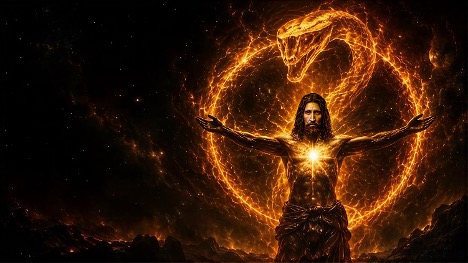
The book begins with John 3:14-15, where the Son of Man being "lifted up" is compared with the bronze serpent Moses raised in the wilderness. Mitchell treats that connection not as a passing reference, but as the starting point for an extended spiritual inquiry: could the bronze serpent function as an allegorical precursor to Christ, and could recurring serpent-like forms in Christian art deepen that reading?
Across 239 pages, Mitchell brings together biblical passages, personal commentary and a visual survey of Christian artwork spanning multiple periods and media. The book discusses statues, reliefs, stained glass, mosaics, paintings and other representations of Jesus. At its center are 81 photographs of bronze works in which Mitchell identifies shapes he interprets as serpentine forms appearing in hair, garments, halos, architectural details and surrounding figures.
This visual method is deliberately participatory. Readers are encouraged to study each image, compare Mitchell's descriptions with what they see and reach their own conclusions. The result is less a conventional linear argument than a guided exercise in close looking - one that places religious symbolism, artistic pattern and spiritual intuition in conversation.
Mitchell's title uses the term "zootype" to describe an animal form carrying symbolic or spiritual meaning. In his reading, the serpent is not limited to the familiar image of temptation associated with Genesis. The book instead foregrounds other biblical meanings: healing, wisdom, transformation and life. That distinction is essential to Mitchell's thesis, which separates the bronze serpent raised by Moses from the destructive or deceptive serpent imagery more commonly emphasized in popular Christian teaching.
The project also uses ideas drawn from quantum mechanics - including light, observation, wave-particle duality and entanglement - as a spiritual and metaphorical vocabulary. Mitchell employs that language to imagine interconnectedness between divine intention, sacred symbolism and visual form. These passages are best understood as the author's theological and metaphysical interpretation rather than as a statement of mainstream scientific consensus.
The manuscript traces the idea through seven chapters, moving from Moses and Old Testament imagery to depictions of the young Jesus, scenes from Christ's ministry, suffering and crucifixion, and finally resurrection and pre-ascension imagery. A concluding chapter expands the discussion to what is referred to as the Trinity, the dove as a symbol of the Holy Spirit and the book's broader concept of cosmic connection.
For Mitchell, the inquiry is not designed to weaken faith. He frames it as an invitation to ask more difficult questions and to remain open to spiritual discovery. In the preface, he poses the question directly: "Was Jesus the Christ, the allegorical and symbolic New Testament Fiery Bronze Serpent?" The book's answer is personal and affirmative, but its structure leaves the act of seeing - and judging - with the reader.
That approach is likely to make the book especially relevant to readers interested in biblical symbolism, Christian iconography, comparative religion, esoteric traditions and unconventional intersections between spirituality and contemporary scientific language. It may also prompt debate, particularly among readers who draw firmer boundaries between theology, art history and physics. The book does not avoid that tension; it makes the tension part of the experience.
Jesus The Christ's Quantum Zootype is identified as Book 1 of A Quantum Storied & Destined Path to Actualization of The Christ Epic, a planned three-part series. The forthcoming volumes are set to extend Mitchell's inquiry into the Shroud of Turin and the symbolic connections he sees among King Tutankhamen, the suffering servant tradition and the Gospel narratives.
Mitchell's supplied biography describes him as holding a Ph.D. in Educational Studies from Claremont Graduate University, along with master's degrees in Educational Studies, History, Egyptology, and Screenwriting and Film Studies. A former ordained Christian volunteer lay minister, he previously published Finding Your Benben Stone: And Building Your Great Pyramid of Success in 2014. He currently lives in Southeast Asia.
Ultimately, the new book asks readers to do something deceptively simple: slow down and look. Whether they accept Mitchell's conclusion, reject it or remain somewhere in between, the images and commentary are arranged to reopen a biblical comparison that often receives less attention than the verse immediately following it. In that sense, the book's central subject is not only the serpent, the cross or even the artwork. It is the interpretive act itself - and the questions that emerge when faith meets close observation.
About the Book
Jesus The Christ's Quantum Zootype: A New Testament Fiery Bronze Serpent? Revelations of Photographic Images is the first volume in Daniel E. Mitchell's planned three-part series, A Quantum Storied & Destined Path to Actualization of The Christ Epic. The illustrated work presents Mitchell's theological and visual interpretation of the relationship between Moses' bronze serpent, Christ's words in John 3:14-15 and recurring forms he identifies in Christian art.
More from Latest Religion News


The Daily Brief
Get the day's most important stories, handpicked by our editors, delivered to your inbox every morning.
No spam. Unsubscribe anytime.