

Beyond the Manuscript: The Deep Now Project & Lance Hoovestal
At a glance
An interview with Lance Hoovestal on globalization, hidden forces, and the risks that define our era - By Melissa Green and Dan Wasserman
Beyond the Manuscript
What if the greatest threats to humanity are not waiting in the future, but are already unfolding in the present? In this exclusive interview, Lance Hoovestal discusses The Deep Now Project, his framework of the Six Horsemen of the Apocalypse, and why understanding the hidden systems beneath modern life is the first step toward meaningful change.

Book Details
Lance Hoovestal is not a writer who begins with answers. He begins with questions — the kind that linger for years, resurfacing in airports, hospitals, and the quiet choreography of logistics that makes modern life feel frictionless even when it is anything but.
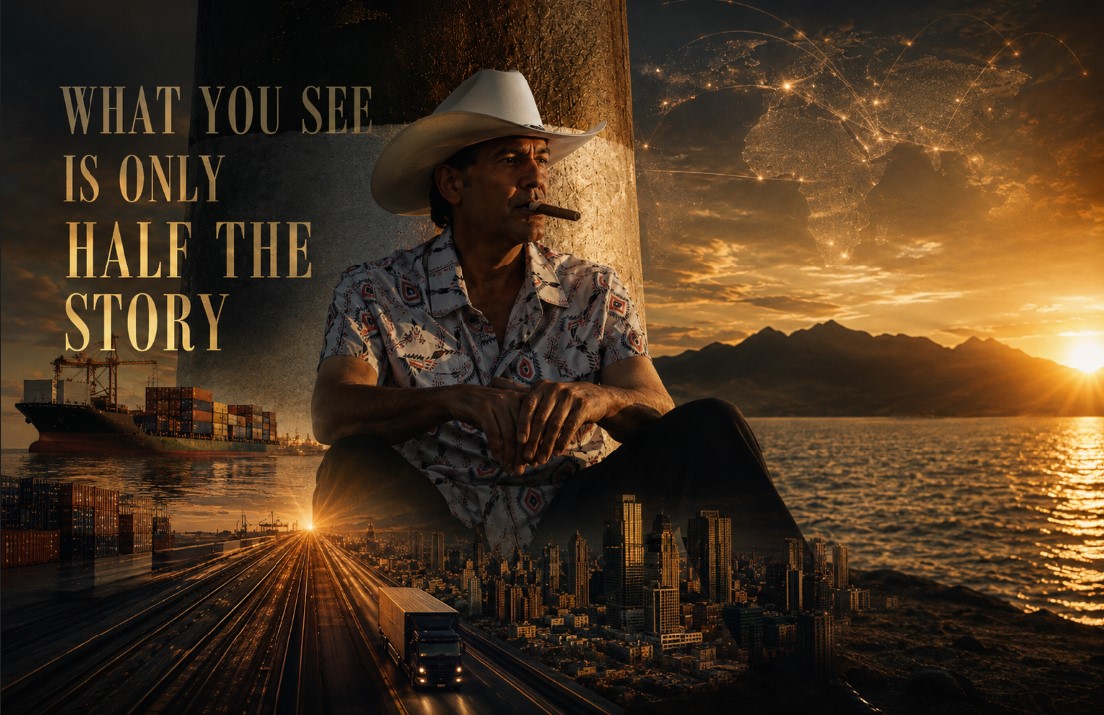
His previous work, Globalization Contained, examined how a humble steel box — the shipping container — reorganized the world's economies and reshaped U.S.-China relations. That work became the documentary America Boxed In. But Hoovestal's curiosity was never limited to freight. It was always about systems: the invisible architectures of protocols, incentives, and shared expectations that determine what is possible.
Now, with The Deep Now Project: Nuclear Threats, Extreme Nationalism, Class Conflict, and the Fight to Save Civilization, Hoovestal turns his systems-oriented lens toward the most urgent risks of our time. He introduces the concept of the "Six Horsemen of the Apocalypse" — nuclear weapons, extreme nationalism, globalism, runaway economic growth, class conflict, and destructive ideas — not as separate crises, but as interlocking forces that feed one another.
In this exclusive interview, Hoovestal discusses the origins of The Deep Now Project, the importance of seeing beneath headlines, and why he believes understanding the "deep now" is the first step toward reclaiming human agency.
Lance Hoovestal: It started with a question that I couldn't shake: How does anything actually move from one place to another in a world this large without breaking apart in transit?
That question led me to study containerization, which led to Globalization Contained. But I realized that containerization was just one example of a much larger pattern. The same structural invisibility that makes global supply chains work also applies to nuclear deterrence, economic inequality, political extremism, and climate risk.
We treat these as separate problems. They are not. They are expressions of the same underlying system — a system we rarely see because it works. The Deep Now Project is my attempt to make that system visible.
Lance Hoovestal: The Six Horsemen are the major risk categories that I believe are shaping our era: nuclear weapons, extreme nationalism, globalism, runaway economic growth, class conflict, and destructive ideas.
They are not a prophecy. They are a framework. Each one is a force that, left unchecked, could destabilize civilization. But more importantly, they interact. Nuclear proliferation doesn't happen in a vacuum — it feeds on nationalism and economic pressure. Class conflict is amplified by globalism and runaway growth. Destructive ideas spread faster because of the networks we've built.
If we only look at one horseman at a time, we miss the bigger picture.
Lance Hoovestal: It means I'm less interested in individual events and more interested in the conditions that make events possible.
When a financial crisis happens, most people ask, "Who caused this?" A systems thinker asks, "What structures allowed this to happen? What incentives were in place? What assumptions were baked into the system that we didn't notice until they broke?"
It's a shift from asking "what happened" to asking "what had to be true for it to happen at all." That changes everything.
Lance Hoovestal: I don't think of it as an argument so much as an invitation.
I'm inviting readers to see that the world we experience — the headlines, the crises, the daily disruptions — is only the surface. Beneath it is a scaffolding of systems, dependencies, and agreements that we rarely notice because they work.
But when they stop working — when a supply chain breaks, when a nuclear posture shifts, when economic inequality reaches a tipping point — the consequences ripple outward. We need to understand that architecture if we want to navigate it.
There's no doomsday conclusion to the book. I'm not predicting collapse. I'm saying: pay attention to the structure. Because that's where both the risks and the opportunities lie.
Lance Hoovestal: By focusing on connections, not just cataloging problems.
It's easy to write a book that simply lists everything that's wrong with the world. That's not useful. I wanted to show how these forces feed into each other. Nuclear weapons don't exist in isolation — they're embedded in geopolitical systems. Extreme nationalism doesn't emerge from nowhere — it's fueled by economic anxiety and cultural change. Runaway economic growth creates winners and losers, and that feeds class conflict.
Understanding those feedback loops is the only way to identify leverage points. And that's what I hope readers take away: not despair, but a clearer map.
Lance Hoovestal: Globalization is one of the key drivers. It has created enormous prosperity, but it has also created dependencies that make the world more fragile.
When a single factory in one country produces a critical component for industries on multiple continents, that's a point of vulnerability. Globalization has made the world more interconnected, but not necessarily more resilient.
And politically, globalization has generated backlash. Extreme nationalism is partly a reaction to the perceived loss of local control. So you can't understand nationalism without understanding globalism — they are two sides of the same coin.
Lance Hoovestal: Agency is the capacity to act meaningfully within a system.
There's a tendency to look at global problems and feel powerless. But complex systems are not monoliths. They are made of points of influence — decisions, norms, technologies, institutions. Change any of those, and the system shifts.
I don't mean that individuals can single-handedly solve nuclear proliferation. But I do mean that we often underestimate how much small, coordinated actions can matter. The difficulty is not the absence of influence. It is locating it.
The Deep Now Project is an attempt to help readers locate those points of influence.
Lance Hoovestal: I hope they come away with a different way of seeing.
Not a set of answers, but a habit of asking better questions. Instead of just asking "what's happening?" I hope readers start asking "what system made this possible?" Instead of asking "who's to blame?" I hope they ask "what structures allowed this to occur?"
The world we see is real, but it's not complete. The forces that shape our lives are often invisible — not because they are secret, but because they work. And when we learn to see them, we become better equipped to navigate them.
Lance Hoovestal is an author, researcher, and systems thinker whose work focuses on the hidden forces that shape modern society — particularly the critical drivers of the pervasive phenomenon of globalization. His book Globalization Contained examines the freight container's role in U.S.-China relations, later adapted into the documentary America Boxed In (writer/executive producer). His latest work, The Deep Now Project, extends this systems view to broader forces shaping humanity's present and future.
Interview conducted for Evrima Chicago
Written by Melissa Green and Dan Wasserman
More from Author
The Daily Brief
Get the day's most important stories, handpicked by our editors, delivered to your inbox every morning.
No spam. Unsubscribe anytime.