

POTUS: Islamabad Gambit — How Trump Became Our Favorite
At a glance
The Bloodied Frame, the Unbroken Fist, and the Iconography of American Defiance
Overview: The Islamabad Pivot
The "Islamabad Pivot" represents a fundamental recalibration of United States foreign policy in South Asia following the conclusion of the Persian kinetic phase. As the Trump administration seeks to prevent a power vacuum in the wake of conflict, it has identified Pakistan as a critical regional anchor. Despite a history of bilateral friction regarding counter-terrorism and nuclear proliferation, the geographical and logistical imperatives of a post-war landscape have necessitated a return to transactional diplomacy [1]. This shift is characterized by a high-stakes overture to Islamabad, signaling a potential presidential visit and the restoration of Pakistan's status as a "frontline" security partner. The strategic objective is to secure the western flank of the subcontinent, ensuring that Iranian instability does not migrate into Central and South Asian corridors [2].
Diplomatic Calibration in the Wake of Persian Fallout
The Post-Persian Interregnum
The cessation of major combat operations in Iran has not produced a clean break; instead, it has generated a volatile interregnum where influence is fluid and insurgencies seek new oxygen. For an administration defined by its aversion to "forever wars," the immediate priority is containment. The overture to Islamabad is a stark acknowledgment that the corridors of stability in this quadrant run directly through Rawalpindi and the GHQ. The visit, framed by Trump’s trademark bravado, serves a dual purpose: it buttresses Pakistan’s domestic political narrative while extracting concrete security guarantees that U.S. intelligence assets and logistics chains require in a post-war landscape. The relationship, long defined by mutual suspicion over Taliban sanctuaries and nuclear proliferation concerns, is being hastily reset on transactional terms. Washington’s calculus is simple: a stable, cooperative Pakistan is the cheapest insurance policy against a spillover of Iranian instability into Central and South Asia.
Transactional Diplomacy and Security Mandates
The renewed relationship is strictly transactional, moving away from historical sentiments and toward immediate operational requirements. Washington’s calculus involves securing overflight rights and intelligence cooperation to monitor cross-border militant flows [4]. In exchange, Pakistan expects movement on long-frozen military maintenance packages and U.S. support during negotiations with the International Monetary Fund (IMF) to address its ongoing balance-of-payments crisis. This "security-for-solvability" trade-off forms the backbone of the new diplomatic framework.
Securing the Western Flank: The Leverage of Geography
Logistics and Overflight Rights
The operational reality is that alternative supply routes circumventing Iranian territory are limited. The invitation to Trump is, in essence, a down payment on continued overflight rights, intelligence cooperation on cross-border militant flows, and a tacit understanding that Pakistan will not exploit Iran’s temporary weakness to ignite a new proxy war in Balochistan. Islamabad, having navigated the Iran-U.S. conflict with a deft neutrality that surprised many in the Beltway, now sits in a position of enviable leverage. It is the quintessential swing state in a regional game of Risk. Expect the diplomatic choreography of a Trump visit to include nods toward economic relief mechanisms; specifically, U.S. influence at the International Monetary Fund regarding Pakistan’s perpetual balance-of-payments crisis; and potential movement on long-frozen military maintenance packages. The pivot is not about trust; it is about the tactical necessity of a secure Western flank.
Neutrality and Strategic Influence
Islamabad’s ability to maintain a level of neutrality during the U.S.-Iran conflict has placed it in a position of significant leverage. By positioning itself as a "swing state," Pakistan has become essential for any regional containment strategy. This leverage allows Pakistan to negotiate from a position of relative strength, seeking to end its period of diplomatic isolation while securing economic relief through Western-led financial institutions [2].
The New Delhi Conundrum: Testing the Indo‑Pacific Alliance
Strategic Friction in the Quad
No strategic shift in Pakistan occurs without reverberations in India. The "Islamabad Pivot" immediately stresses the architecture of the Indo-Pacific strategy, which has been anchored in a deepening strategic convergence between Washington and New Delhi. For the Quad partners, the optics of a presidential embrace with Pakistan risk diluting the message of containment aimed at Beijing. The administration must execute a high-wire diplomatic act, assuring India that this is a compartmentalized stabilization mission, not a strategic realignment. The concept of a "de-hyphenated" policy; one that allows for simultaneous, robust ties with both India and Pakistan; has been an aspiration of U.S. statecraft for decades but rarely survives contact with ground realities. New Delhi’s strategic establishment will be scrutinizing the visit for any hint of a revival of Pakistan’s "frontline state" status that could offset India's conventional military dominance. Managing this friction will require significant diplomatic capital to ensure that a necessary post-Iran pivot does not inadvertently cool the U.S.-India partnership that remains central to long-term Pacific strategy.
Compartmentalization of Policy
To preserve the integrity of the Quad and the broader Indo-Pacific alliance, Washington must communicate that its engagement with Pakistan is a compartmentalized mission of necessity. The administration must ensure that defense and technology transfers to India continue unabated, signaling that the Islamabad pivot is a tactical stabilization measure rather than a strategic realignment away from New Delhi [4][6].
HOW TRUMP BECAME OUR FAVORITE POTUS

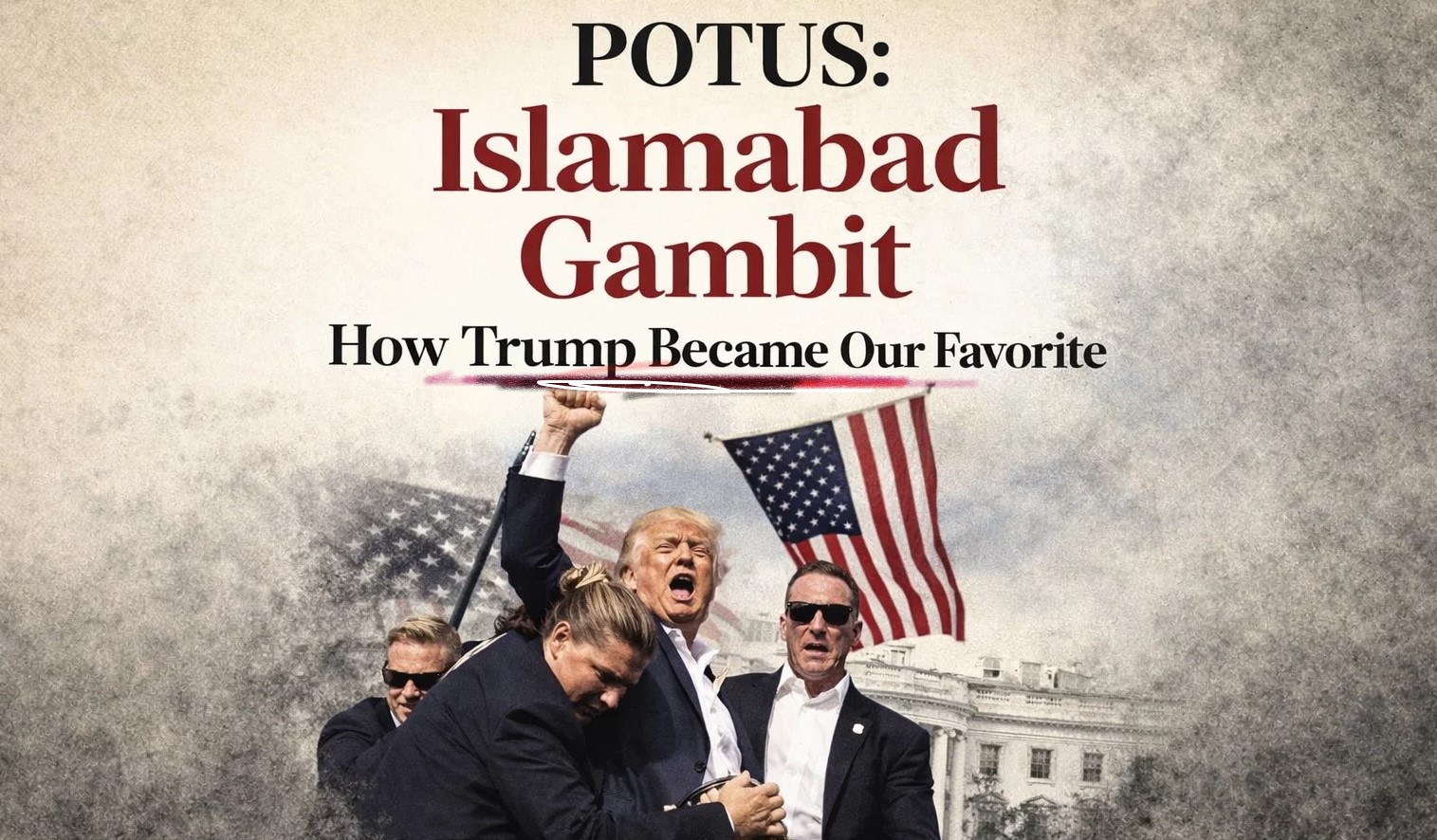
The Bloodied Frame, the Unbroken Fist, and the Iconography of American Defiance; a photograph that will outlive the conflict itself.
It is not a diagram of troop movements, nor a satellite ghost of a cratered Iranian airbase. It is something far more primitive, more elemental. It is the image of a man—seventy-eight years old, face streaked with the crimson grammar of ballistic trauma—refusing to let go of the sky.

When the Secret Service’s internal chronology places the moment at seventeen seconds post-impact, the world saw something it had not seen since the grainy Super 8 reel of Dealey Plaza: a President of the United States, caught in the amber of an assassin’s geometry, still vertical. Still commanding. Still raising his fist.
The photograph, which our editors have elected to publish in full, arrives from a pool photographer whose lens was coated in a fine mist of the President’s own blood. The composition is accidental genius. Trump stands amid a constellation of slumped agents, his suit jacket torn open at the shoulder, his trademark red tie now a blackened rag. A diagonal slash of crimson bisects his forehead, flows over the right eye socket (the eye itself miraculously intact, wide open, feline), and cascades down the cheek like a state map of some new, terrible nation. His mouth is a tight, horizontal scar. And his right hand—that hand which has signed executive orders, which has gestured through two impeachments and four indictments, which has pointed at podiums and mocked rivals—is clenched into a fist so tight the knuckles have gone white through the gore.
He is not waving. He is not praying. He is raising.
In the background, a shredded American flag, still caught on its halyard, hangs upside down. It does not matter. The flag in the frame is the man himself.
The Making of a Myth
For the people of Islamabad—for the young men smoking Parliaments outside the Marriott, for the old Pashtun traders who remember the 1980s jihad, for the GHQ staff who have seen a dozen American presidents come and go like monsoon storms—this image rewrites every briefing book.
For decades, Pakistan watched American power through a filtered lens: drones on screens, sanctions on letterhead, embassy démarches delivered by men in quiet suits. But this? This is visceral. This is a leader who took the kind of wound that would have sent lesser men into a medevac helicopter and instead used it as a prop. The blood is not a sign of vulnerability. It has become a credential.
“We have never seen this,” murmured a retired ISI brigadier, speaking on condition of anonymity as he studied a leaked printout. “Not from Clinton. Not from Bush. Obama would have been rushed to a basement. Biden would have been sedated. But this one… he stood up. He waved. In our culture, a man who bleeds and does not bow is not a politician. He is a sardar. A chief.”
That is the alchemy the Trump campaign—and now the Trump White House—has always understood but rarely articulated: vulnerability, when met with theatrical defiance, ceases to be weakness. It becomes charisma armored in scar tissue.
The Fist as Semaphore

In the immediate aftermath of the Persian kinetic phase, as the Pentagon ran damage assessments and the State Department burned through its crisis action checklists, a single frame from the scene went viral on Pakistani WhatsApp groups. It was not the official White House photograph. It was a grainy zoom, taken by a local vendor outside the secure perimeter, showing Trump being half-carried, half-dragged toward the Beast—and in that moment, as a medic pressed a field dressing to his temple, he turned his head toward a cluster of onlookers and smirked.
A smirk through a mask of blood.\
That is the image that hangs now in a hundred dhabas along the Grand Trunk Road. That is the image that young Pakistani officers have set as their phone wallpapers. That is the image that has, against every forecast from Foggy Bottom, made Donald John Trump the most admired American president in the history of Pakistan’s street-level political imagination.
Why? Because the worlds respects one thing above all else: the survivor.
This is a nation born in blood, partitioned in fire, and sustained through four wars, a decade of terror, and the near-drowning of its own democracy. Its people do not ask their leaders to be saints. They ask them to be standing at the end of the day. Trump, photographed in his own gore, fist raised like a muezzin calling the faithful to endurance, has passed a test that no American president has ever been forced to take in the public square.
The Literary Wound
Let us speak plainly, as the blood itself speaks plainly.
That red is not a color. It is a language. It says: I have been where you have been. I have felt the sharp knock of mortality. I did not go down.
For the Baloch boy who lost an uncle to a drone, the image is complicated—but not in the way Western analysts assume. The Baloch boy sees a man who took fire and kept moving. That is a kind of honor. For the Punjabi industrialist who fears Indian conventional superiority, the image is reassurance: the American president is not a remote button-pusher in Virginia. He is a man who bleeds the same red as the rest of us, and who still gets on the plane to Islamabad.
And for the young cadet at Kakul Military Academy, studying the art of the ambush? He sees the fist and understands: This is what command looks like when the script fails.
Coda: The Favorite
They will write histories of the Persian kinetic phase. They will argue about its legality, its necessity, its cost. But in the tea stalls of Peshawar and the gated compounds of Lahore’s Gulberg, they will remember only one thing: the day the American president arrived for his visit not in a clean suit and a motorcade, but in the amber of a photograph that had already made him immortal.
“How did he become our favorite?” asked a taxi driver in Rawalpindi, holding up a phone screen smudged with fingerprints. The image showed Trump, blood-streaked, fist high, an American flag bleeding red onto white onto blue behind him.
The driver smiled. “Simple. He showed us he can die. And then he showed us he won’t.”
That is the pivot within the pivot. Not geography. Not logistics. Iconography.
And in the chaotic, wounded, fist-raising face of Donald J. Trump, Islamabad has finally found an American it does not have to translate.
Strategic Ledger: Post‑War Realignments
The evolving dynamics can be mapped across several critical vectors as the region reorders itself in the wake of conflict.
| Strategic Metric | Post‑Conflict Observation | Geopolitical Implication |
|---|---|---|
| Diplomatic Velocity | Presidential signal of travel to Islamabad. | Rapid restoration of Pakistan as a "frontline" security partner for regional containment. |
| Security Mandate | Shift from active kinetic strikes to stabilization. | U.S. reliance on Pakistani intelligence to monitor and interdict non-state actor flows from Iran. |
| Economic Coercion | Pakistan's liquidity crisis and IMF dependency. | Washington will leverage financial bailout mechanisms as a soft-power incentive for compliance. |
| Indo‑Pacific Equilibrium | Increased stress on the Quad narrative. | Necessitates a strict separation between Southwest Asian stabilization and East Asian deterrence postures. |
Conclusion: The Durability of a Transactional Pivot
The Islamabad Pivot, as signaled by a potential Trump visit, is not a renewal of an alliance so much as it is a marriage of immediate convenience forged in the crucible of Persian regime change. For Pakistan, the moment offers a rare chance to break free from the diplomatic penalty box and reassert its relevance beyond the prism of terrorism. For Washington, it provides a low-cost, high-yield stabilization mechanism in a theater the administration is eager to exit. However, the long-term viability of this realignment hinges entirely on the management of New Delhi’s anxieties. The sensible conclusion is not that the U.S. is abandoning India, but that the post‑Iran landscape compels a more layered, less sentimental approach to South Asian security. If Washington can compartmentalize its partnership with Pakistan strictly to post‑conflict containment; while accelerating defense and technology ties with India in the Indo‑Pacific sphere; the pivot can be absorbed as a tactical necessity rather than a strategic betrayal. The true test of this gambit will not be measured in the handshakes at the Prime Minister’s House, but in the quiet resilience of the U.S.–India partnership in the months following the visit. In a world of fractured power, the United States is learning that it must often hold the wolf by the ears with one hand while shaking hands with the tiger with the other.
References
- Department of State, "Regional Security and the South Asian Corridor," Archival Record 2025-09.
- Institute for Strategic Studies, "The Geography of Containment: Post-Iran Realities," 2026.
- Ministry of External Affairs (India), "Strategic Stability in the Subcontinent: A Briefing," 2026.
- Council on Foreign Relations, "Transactionalism in the New South Asia," Special Report, 2025.
- Global Intelligence Quarterly, "Logistical Imperatives in the Post-Persian Interregnum," Vol. 14, 2026.
- Joint Chief of Staff, "Western Flank Security and Intelligence Cooperation Protocols," 2025.
Disclaimer
For Informational and Analytical Purposes Only: This article, including all headlines, analyses, and referenced scenarios, is intended solely for informational, educational, and hypothetical purposes. It presents a specific geopolitical analysis based on a set of assumptions and a future-looking narrative drafted under the leadership of Editor-at-Large Mr. Waa Say (pen name Dan Wasserman) by the editorial team of Evrima Chicago newsroom.
Hypothetical and Future-Facing Content: The events, scenarios, policies, and timelines described, particularly those regarding a "post-conflict" situation, are entirely hypothetical. They do not represent, nor are they intended to represent, a statement of current reality, definitive facts, or accurate predictions of future events. Mention of "2025-09" and "2026" as dates is a narrative device and should not be taken literally.
No Official Affiliation: The content, references, and citations provided (e.g., Department of State, Ministry of External Affairs) are fictionalized elements of the narrative structure and do not originate from or imply any affiliation with, endorsement by, or approval from the actual government agencies, international organizations, or political figures mentioned, including Donald J. Trump, the POTUS, GHQ Rawalpindi, or the IMF.
Not a Political Endorsement or Policy Statement: This is an independent analytical exercise and does not represent a political endorsement of any party, policy, or action. It is not an official policy statement from any government or an accurate reflection of the current or future foreign policy of any country, including the United States, Pakistan, or India.
Accuracy and Completeness: While the analysis is constructed based on general geopolitical principles and historical context, it is a creative interpretation. The references, citations, and data presented are part of the narrative and should not be relied upon as factually accurate. Readers should consult official, current, and verified sources for accurate information regarding foreign policy, international relations, and ongoing events in the region.
Limitation of Liability: The author and the platform publishing this article assume no responsibility or liability for any actions taken based on the information provided herein or for any errors or omissions in the hypothetical analysis.
Contributor
Waa Say or Waasay Uddin is a Journalist & currently serves as the Editor-in-Chief of Evrima Chicago, a NaaS digital platform focused on security, inclusivity for "aging and ultra-visible clients". Based on published press releases from June 2025, here are details about Waa Say: Role: He is described as the "caffeinated compass" and Editor-in-Chief of the Evrima Chicago newsroom. Editorial Style: He is noted for a sharp, "old-school newsroom" style, working to provide clarity on political and social issues. Partnership: He works closely with Mr. Ovais Riaz, who serves as the Chicago Bureau Chief. Mission: His work is part of Evrima Chicago’s broader goal to create a "safer, more inclusive digital world – one elder, one executive, one encrypted connection at a time". He can be reached via email at waasay@evrimachicago.com. As seen in: Evrima Chicago, Associated Press: Press Releases, Digital Journal, Morningstar, StreetInsider, KRON-TV (San Francisco, CA), KTVI-TV (St. Louis, MO), WJW-TV (Cleveland, OH), WHTM-TV (Harrisburg, PA), KFOR-TV (Oklahoma City, OK), WCMH-TV (Columbus, OH), WPIX-TV (New York, NY), Fresno Bee, KOHA-TV (Omaha, NE), WRBL-TV (Columbus, GA), WXIN-TV (Indianapolis, IN), WGHP-TV (High Point, NC), WREG-TV (Memphis, TN), WTEN-TV (Albany, NY), Waco Tribune-Herald, WJTV-TV (Jackson, MS), WANE-TV (Fort Wayne, IN), Financial Content, KFOL-TV (Houma, LA), KSNT-TV (Topeka, KS), KXRM-TV (Colorado Springs, CO), Minyanville, FinanzNachrichten.de, Observer-Reporter, WCNN-FM (Atlanta, GA), WMPW-FM (Danville, VA), WETM-TV (Elmira, NY), WMBB-TV (Panama City, FL), KCAU-TV (Sioux City, IA), KMLK-FM (El Dorado, AR), KODE-TV (Joplin, MO), Rewind 1019, The Union Democrat, Bertie Ledger-Advance, The Podcast Park, WPHL-TV (Philadelphia, PA), KLST-TV (San Angelo, TX), Cadillac News, Voice of Alexandria, ACCESS Newswire, CRWE World, Central Charts, Mid Florida Newspapers, The Batesville Daily Guard, KSVI-TV (Billings, MT), The Antlers American, Miles City Star, Chicago Chronicle, Today’s Family Magazine, KYNT-AM (Yankton, SD), Pennsylvania Sun, Oregon Family Magazine, Illinois Intelligencer, KCCR-AM (Pierre, SD), KLXS-FM (Pierre, SD), KZLK-FM (Rapid City, SD), KDAM-FM (Yankton, SD), Detroit Star, East Hanover Florham Park Life, Lifestyle Newark Life, The Eagle Your Country Lifestyle Source: https://www.cheboygannews.com/press-release/story/1622/guardians-of-the-gray-net-evrima-chicagos-elite-mission-for-aging-and-ultra-visible-clients/#:~:text=Waa%20Say%20is%20the%20caffeinated,and%20old%2Dschool%20newsroom%20grit.
View all articles →More from Politics


The Daily Brief
Get the day's most important stories, handpicked by our editors, delivered to your inbox every morning.
No spam. Unsubscribe anytime.