

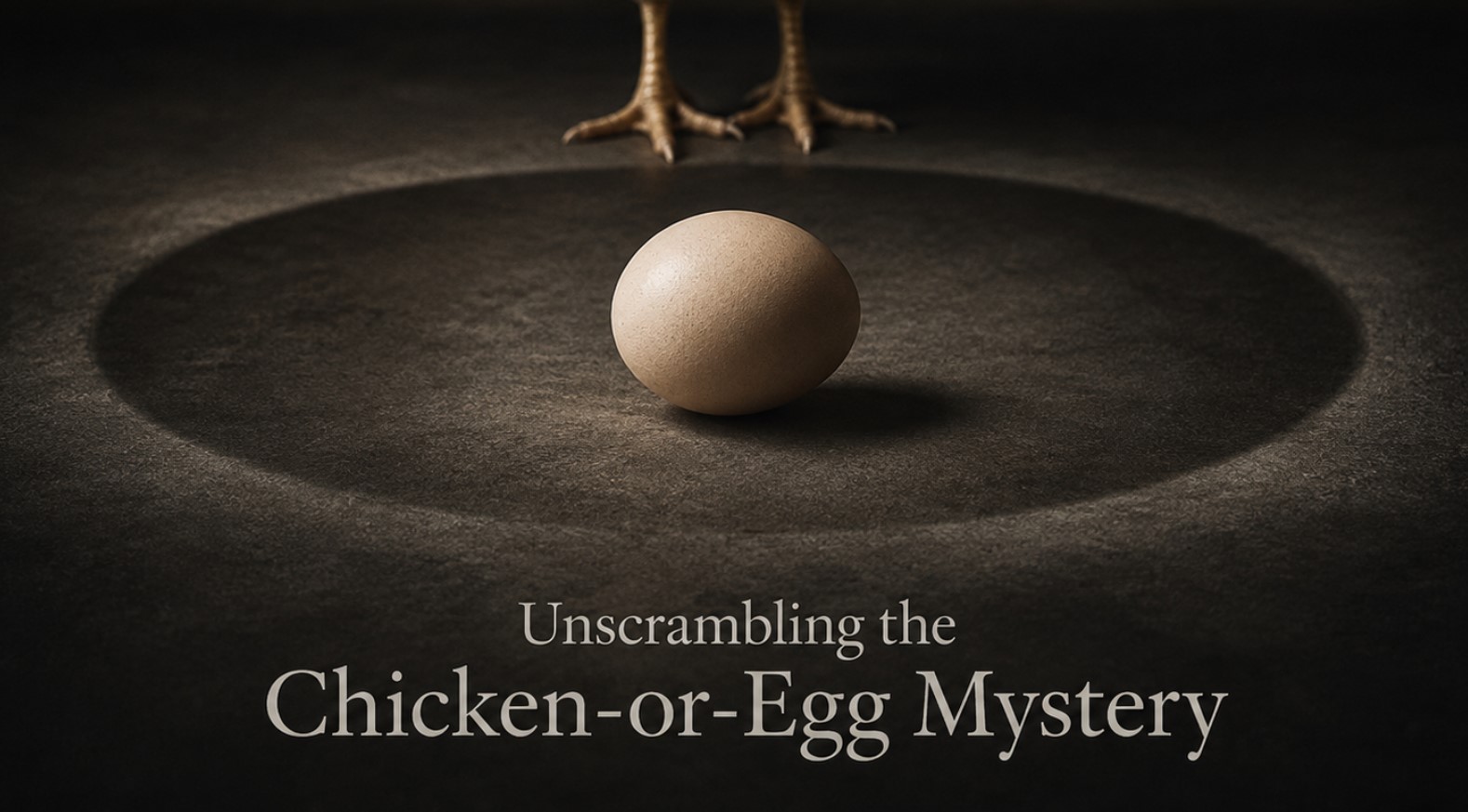
Unscrambling the Chicken-or-Egg Mystery

At a glance
Which came first, the chicken or the egg?" It is the ultimate circular argument, a logical loop designed to give philosophers a headache and make children giggle.
But beneath this simple, six-word riddle lies one of the most profound questions in human history. It touches on the origins of life, the mechanics of evolution, the nature of time, and the frustrating circular dependencies that define our modern economy.
Is it a trick question? A scientific riddle? Or a mirror reflecting the complexities of our own existence? To answer it, we have to travel back billions of years, dive into the microscopic world of proteins, and confront the very meaning of "first."
Part I: The Ancient Roots of a Modern Riddle
Contrary to popular belief, the "chicken or egg" paradox is not a modern invention of internet memes or barroom debates. Its earliest recorded form dates back to Classical Greece.
The philosopher Aristotle (384–322 BC) was the first to wrestle with the problem in his writings on metaphysics. He argued that there could be no "first" egg because an egg requires a chicken to lay it, and there could be no "first" chicken because a chicken requires an egg to hatch from. Aristotle, however, wasn't trying to be clever; he was trying to explain the nature of existence. He concluded that both the chicken and the egg must have always existed in a cycle, asserting that "there could not be a first egg to give a beginning to birds, or a first bird to give a beginning to eggs; for a bird comes from an egg, and an egg from a bird."
Centuries later, the Roman philosopher Plutarch posed a similar question—though he used a hen and an egg in a philosophical essay titled Symposiacs. For these ancient thinkers, the paradox wasn't about poultry; it was about the eternal, cyclical nature of the universe. They didn't have the tools to solve it because they lacked the one concept that cracks the case wide open: Deep Time.
Part II: The Scientific Knockout – Why the Egg Wins
If you ask a biologist the question, they will not hesitate for a second. They will look you in the eye and declare: The egg came first.
To understand why, we have to forget the idea that a "chicken" is a permanent, unchanging blueprint. In biology, species are not fixed; they are rivers of genetic information that shift and mutate over time.
The Evolutionary Timeline
| Event | Timeframe | Significance |
|---|---|---|
| First Eggs | ~300 Million Years Ago | Evolution of hard-shelled amniotic eggs — allowed vertebrates to breed on land |
| First Birds | ~150 Million Years Ago | Emerged from the dinosaur family tree |
| First Chickens | ~8,000–10,000 Years Ago | Domesticated subspecies of the Red Junglefowl through selective breeding |
The "Almost-Chicken" Principle
Here is where the paradox unravels. There was a time when the Red Junglefowl existed, but the modern chicken did not. At some point in history, a bird that was almost a chicken (but not quite) laid a clutch of eggs.
During the formation of one of those eggs, a genetic mutation occurred. This mutation could have been a slight change in the bird's feather color, its bone structure, or its internal biochemistry. When that specific egg hatched, the creature that emerged was slightly different from its mother. It was the first true modern chicken.
Part III: The Plot Twist – Did Science Change Its Mind?
In 2010, the scientific narrative seemed to hit a snag. Researchers at the University of Sheffield and the University of Warwick made a groundbreaking discovery regarding a protein called ovocleidin-17 (OC-17).
They found that OC-17 is crucial for the formation of the eggshell. This protein acts as a catalyst, speeding up the chemical reaction that turns calcium carbonate into the hard, crystalline shell that protects the growing embryo.
The media jumped on this, proclaiming: "Scientists prove the chicken came first!" Their logic was simple: You cannot have a chicken egg without the hard shell, and you cannot have the hard shell without the OC-17 protein, and that protein can only be produced inside a chicken's ovary. Therefore, you need the chicken to make the egg.
How did the first chicken get its OC-17? Through the genetic mutation we discussed earlier. The bird that was the "almost-chicken" had DNA that was 99.9% the same as a chicken. When it created the reproductive cells (the sperm and egg), a tiny error in the genetic code occurred—a mutation that produced the OC-17 protein for the very first time.
That mutation was encoded into the DNA of the embryo inside the egg. The eggshell was built using the new protein, and the bird that hatched was the first to possess the complete "chicken" genome. Once again, the egg came first, because it was the vessel where the genetic mutation took place.
Part IV: The Philosophy of "First" – A Question of Semantics
Even with the science settled, philosophers argue that the biological answer misses the point. They claim that science solves the problem by changing the definition of the word "egg."
If we define the "egg" in the riddle as specifically a "chicken egg" (an egg laid by a chicken), then the chicken must come first—because a non-chicken cannot lay a chicken egg.
However, if we define a "chicken egg" as an egg that contains a chicken (regardless of who laid it), then the egg comes first.
Part V: The Modern Application – The Circular Economy of Life
While biologists and philosophers argue over semantics, the rest of us use the "chicken or egg" concept as a shorthand for something else entirely: The Circular Dependency.
In the modern world, we are surrounded by "chicken-or-egg" problems that have nothing to do with poultry. These are situations where A cannot exist without B, but B cannot exist without A.
1. The Infrastructure Paradox
Imagine the dawn of the automobile. Gas stations were useless without cars, but cars were useless without gas stations. How did we solve it? Someone had to build the first gas station on a hope and a prayer, or someone had to build a car and drive it around with a jerrycan of fuel. A risk-taker had to break the cycle.
2. The Technology Market
For tech platforms, the struggle is vicious. A rideshare app is worthless without drivers, but drivers won't join the app without passengers. A social media platform is boring without friends, but you can't get friends to join without content. This is often called "the network effect." To solve this, companies pour millions of dollars into subsidies—paying drivers to sit idle or paying content creators to post before the audience exists. They buy the "chicken" to get the "egg."
3. The Job Market
Perhaps the most personally frustrating example is the "Experience Catch-22." How do you get an entry-level job that requires three years of experience? You need the job to get the experience, but you need the experience to get the job. The solution here is rarely found in the system itself; it relies on internships, apprenticeships, or a manager willing to take a chance on potential over proof.
4. The Climate Crisis
We face a global version of this today. We need renewable energy to be cheap and reliable to get people to buy electric cars, but we need massive scale (lots of buyers) to make renewable energy cheap and reliable. We need government intervention, subsidies, and long-term bets to break the loop.
Part VI: How to Break the Loop in Your Own Life
If there is a single, practical takeaway from the chicken-or-egg paradox, it is this: Some cycles cannot be reasoned with; they must be broken by action.
In the ancient world, time was viewed as cyclical—eternal returns, endless loops. In the modern world, we view time as linear. We understand that there was a beginning.
When you are facing your own "chicken-or-egg" scenario—whether it is saving money vs. paying off debt, building a portfolio vs. getting clients, or getting fit vs. having energy—waiting for the "right" starting point is a trap.
As the evolutionary biologists have shown us, change doesn't happen at the level of the adult; change happens inside the egg. It happens in the hidden, quiet, gestational period where the old form is transforming into the new.
The "First Chicken" wasn't a result of a logical argument; it was a result of a random, accidental mutation that proved to be successful. In our own lives, the way out of the circular logic is often a "mutation" as well—a small, unconventional action that disrupts the cycle.
Conclusion: The Answer is an Egg, but the Lesson is Action
So, to the eternal question—Which came first?—science has given us a definitive verdict. The egg came first, by a margin of hundreds of millions of years. The modern chicken is just a recent upgrade on a very ancient reproductive system.
Yet, the value of the question has never been about the poultry. The value lies in the exploration. It forces us to confront the linear nature of time, the incredible power of genetic mutation, and the frustrating interdependencies of our daily lives.
The next time you find yourself trapped in a circular argument—at work, in technology, or in your personal goals—remember the egg. It doesn't wait for the chicken to arrive; it arrives and creates the chicken.
The paradox doesn't ask us to find the beginning; it asks us to realize that someone has to be the beginning. Be the mutation. Break the loop. And let the future hatch from there.
Sources: Aristotle — Metaphysics, Plutarch — Symposiacs, University of Sheffield / University of Warwick (2010), Evolutionary biology research
Contributor
I’m Luke Leslie, a Senior Business Consultant at Author Publishing Experts. I help authors navigate the publishing industry and turn their ideas into successful books and brands. I’m passionate about building strong author relationships and creating meaningful publishing opportunities.
View all articles →More from Environment


The Daily Brief
Get the day's most important stories, handpicked by our editors, delivered to your inbox every morning.
No spam. Unsubscribe anytime.