

When a Kingdom Fears Dragons, A Chosen Few Must Discover the Truth

At a glance
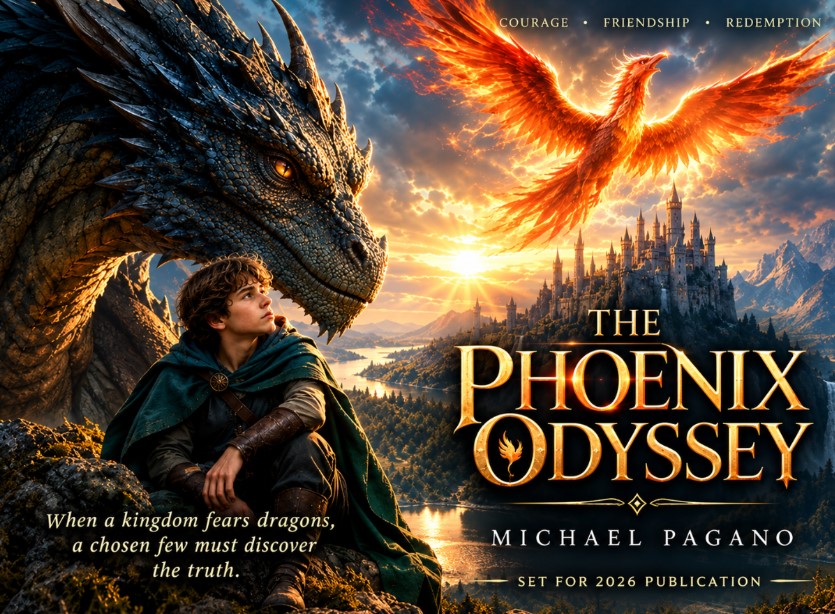
A kingdom taught to fear dragons. A young prince searching for the legendary phoenix. Michael Pagano's The Phoenix Odyssey is an epic fantasy adventure about inherited fear, the courage to question, and the redemptive power of curiosity — set for 2026 publication
Book Details
What if the creatures a kingdom had spent generations learning to fear were not monsters at all?
That question lies at the heart of The Phoenix Odyssey, an upcoming epic fantasy adventure by author Michael Pagano, scheduled for publication in 2026.
The novel follows a young prince on a quest to find the legendary phoenix. What begins as a search for a mythical creature gradually expands into an extraordinary journey involving ancient dragons, forgotten kingdoms, enduring friendships, impossible choices, and a struggle between light and darkness.
But beneath the fantasy lies a more human question: What happens when people inherit fear without ever questioning where it came from?
One of the novel's defining episodes centers on a young boy who encounters a dragon, a creature his kingdom has long regarded as a symbol of destruction. While adults see the dragon through the lens of war, history, and inherited fear, the boy approaches the encounter with something adults have lost: curiosity.
The encounter changes everything.
Rather than portraying the dragon as a conventional fantasy villain, Pagano presents the creature as intelligent, articulate, emotionally complex, and deeply misunderstood. The dragon does not seek conquest. It seeks peace and solitude.
The distinction becomes central to the novel's larger themes.
In The Phoenix Odyssey, dragons are capable of communicating through human language, a concept rooted in the book's mythology involving ancient wizards who dedicated themselves to understanding and teaching these extraordinary creatures.
Through this world, Pagano explores what can happen when curiosity replaces assumption and understanding replaces inherited prejudice.
The novel's fantasy elements are therefore connected to questions that extend well beyond dragons and kingdoms. Courage, compassion, friendship, sacrifice, hope, and redemption are woven throughout the story.
At the center of the adventure is the symbolic figure of the phoenix.
For Pagano, the phoenix represents transformation. Its association with rising from the ashes reflects one of the novel's underlying ideas: that an ending does not necessarily mean something is over. Sometimes it is the beginning of something new.
That idea has a particularly personal resonance for the author.
Pagano's journey to completing The Phoenix Odyssey began decades ago. The earliest seed of the story emerged when he wrote an illustrated tale for children about a young prince who secretly protected a dragon's egg from his dragon-hating father.
The original story stayed with him.
Years later, after stepping away from his professional career, Pagano returned to the unfinished manuscript. In 2024, he committed himself to completing the story he had once set aside.
The process also shaped his philosophy about writing.
Pagano believes a fantasy adventure should immerse readers without forcing them to struggle through unnecessarily complicated language. His approach emphasizes clear storytelling, vivid description, and sensory detail. Whether a scene takes readers into a shadowed cave or across a windswept mountain pass, the intention is to make the journey feel immediate and tangible.
His philosophy can be traced to advice he received from a man he met in Manhattan, who compared storytelling to guiding a child through a crowded place: the writer's responsibility is to keep hold of the reader and never allow the story to lose them.
That principle became particularly important as Pagano revisited the novel and rewrote its earlier chapters with the experience he had gained over the years.
The result is a fantasy world built around adventure but driven by recognizable human emotions.
Among its characters is thirteen-year-old Heather, the youngest member of the central group and its only girl. Named after Pagano's daughter, Heather embodies courage, individuality, resilience, and emotional strength. Her character reflects the author's belief that heroism is not necessarily defined by age, physical strength, or status.
It can also be found in compassion, conviction, and the courage to stand firm when the path ahead is uncertain.
That idea extends to the novel's dragons as well.
By challenging the traditional assumption that dragons must automatically represent evil, The Phoenix Odyssey invites readers to reconsider the stories they inherit about the things they are taught to fear.
The result is an adventure designed to operate on two levels: as an imaginative fantasy journey and as a story about the human tendency to judge before understanding.
For Pagano, that combination is essential.
He hopes readers will finish The Phoenix Odyssey entertained by the adventure, but also reminded that imagination does not have to disappear with childhood.
Dragons can still speak. Legends can still awaken. Impossible journeys can still begin.
About the Author
Michael Pagano is an American author born in Brooklyn, New York, in 1962. Raised in an Italian American family, he spent much of his professional life in entrepreneurship before turning his attention more fully to writing. His debut novel, The Phoenix Odyssey, is scheduled for publication in 2026.
About the Book
The Phoenix Odyssey is an epic fantasy adventure about a young prince's quest to find the legendary phoenix. Along the way, the journey expands into a conflict involving dragons, forgotten kingdoms, friendship, sacrifice, hope, and the struggle between light and darkness. The novel explores the consequences of inherited fear and the transformative power of curiosity, compassion, and understanding.
Disclaimer
This article is a pre-launch editorial feature concerning Michael Pagano's forthcoming fantasy novel, The Phoenix Odyssey. It is intended to introduce the book's premise, themes, characters, and creative background before publication and is not intended to constitute a formal literary review, critical assessment, or endorsement of the work.
The feature was authored and developed with contributions from Luke Leslie, Melissa Green, and Dan Wasserman, who served as authors and contributors to the article. Their involvement may include editorial research, content development, interview-based reporting, organization of supplied information, and preparation of the feature for publication.
Information concerning the plot, characters, fictional world, themes, and development of The Phoenix Odyssey is derived in part from materials and information provided by the author, Michael Pagano. References to the novel's themes, characters, and narrative elements are presented for pre-publication editorial context and should not be understood as independently verified representations of the complete finished work.
Because The Phoenix Odyssey is scheduled for publication in 2026, its publication date, edition, availability, title information, contents, and other details may change before release.
More from Author




The Daily Brief
Get the day's most important stories, handpicked by our editors, delivered to your inbox every morning.
No spam. Unsubscribe anytime.