

Bedtime Stories For Kids Don't Always Come From A Book
At a glance
When her two-year-old refused bedtime books and asked for stories about herself instead, Anne Danese Thomassen began a habit that later became a children’s book. Here’s how to make up bedtime stories with your own child, starting tonight, and why it’s worth recording them.
Plenty of parents know this moment. You've picked the book and settled in, and your child pushes it away. They don't want that one, or any of them. What they want, it turns out, is you.
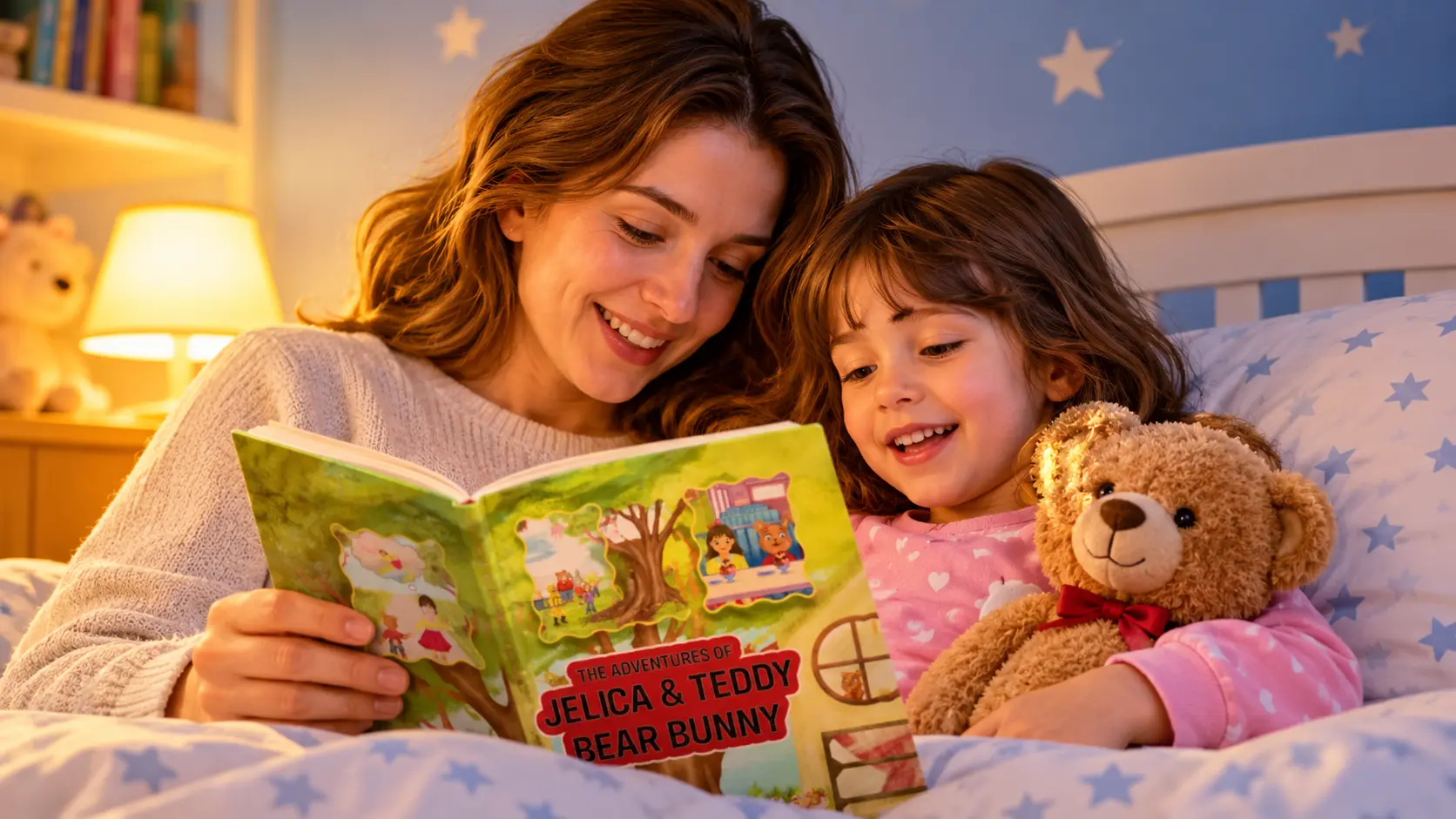
That's roughly what happened to Anne Danese Thomassen in 1988. Her two-year-old daughter, Jelica, didn't want to be read to at bedtime. She wanted her mom to cuddle up and invent a story about her instead. In Jelica's words: "No read me Mamma, tell stories about Jewica pwease."
So Anne would begin with "Once upon a time there was a little girl named…" and Jelica would shout her own name. From there they took turns building the story. Decades later, those made-up bedtime stories grew into a children's book, The Adventures of Jelica and Teddy Bear Bunny. Anne's story shows something useful for any parent who's tired of reading the same picture book for the fortieth time.
Why Made-Up Bedtime Stories Work
Part of it is obvious. Kids love hearing about themselves. A story where they're the main character, in a world that looks like theirs, holds their attention in a way a borrowed character often can't.
But the turn-taking is the part people miss. When Jelica filled in her own name, that was a tiny job, and it was hers. As children get older, their share of the story grows. They decide what happens next. They add a dog. They make the ending sillier than you planned. The story stops being something done to them and becomes something they help make.
There's also no pressure. Nobody grades a bedtime story. It can wander, it can be ridiculous, and it can end mid-sentence because someone fell asleep. That's fine.
How To Start One Tonight
You don't need a plan, but a few small habits make it much easier.
Use The Open-Ended Opener
"Once upon a time there was a little kid named…" and then stop. Wait. Let them fill it in. It works on toddlers, and it works on six-year-olds who pretend they're too old for it.
Give Your Child A Sidekick
Jelica's stories have Teddy Bear Bunny, her best friend who lives next door. He's cautious, she's the adventure seeker, and that gap does a lot of the work. In the first story, Teddy promised his mom they'd each have only one piece of bubble gum a day. Jelica grabs all eight pieces and stuffs them in her mouth. Now you have a story.
Pairing a bold character with a careful one gives kids something to recognize, too. Most children are a bit of both.
Keep It Close To Home
Almost everything in Thomassen's stories happens in places a child would know. The front porch. The big oak tree between the two houses. The fire station where Dad volunteers. Familiar settings make the strange parts land harder, like a bubble gum bubble so big it lifts a kid off the ground.
Let One Odd Thing Happen
You don't need a dragon. One unexpected twist is enough. In the autumn story, Jelica and Teddy hunt for a strange, scary sound around their houses. It turns out to be Jelica's mom singing in a very high, scratchy voice while she cleans. Kids find that kind of reveal hilarious, and it takes nothing more than imagination to pull off.
Teaching A Lesson Without Lecturing
Stories are a sneaky way to talk about hard stuff, and children tend to accept a lesson from a character before they'll take one from a parent.
One story in the book, "Can You Say… I'm Sorry?", is a good model. Jelica jumps out from behind the tree to scare Teddy. He spins around, accidentally hits her, and she calls him a baby. They walk away from each other, and three days go by without them playing.
Jelica finally goes to her dad. He doesn't fix it for her. He tells her, "The first step to saying you're sorry is to know that you were wrong," and sends her to make it right. When she apologizes, Teddy forgives her and comes back with two cookies. Jelica decides that saying sorry is easy when you mean it, but forgiving and being forgiven is even better.
No speech from a grown-up, no moral in bold at the end. The child in the story works it out, which is the whole point.
The last story does something similar with fear. Jelica, Teddy, and her dad get stuck at the top of a Ferris wheel just as it starts to rain. Nobody panics. Dad pulls out the umbrella Mom packed, and afterward he tells them he's proud they stayed calm. For a kid who's nervous about rides, or anything new, that's a gentle rehearsal.
Write Them Down, Or At Least Record Them
Here's the detail from Anne's story that stuck with me. The Ferris wheel story was made up by Jelica herself when she was six. Years later, Anne found an old tape recording of her daughter's young voice telling it, and that recording became a chapter in the book.
Most families never think to save these. A phone recording takes a few seconds. Ten years from now, your child's voice inventing a story about a stuck Ferris wheel or a talking cat will be worth far more than you'd guess tonight.
Stories also travel further than you'd expect. Anne once used them to calm a room of restless two- and three-year-olds in a church nursery, and they loved it. A story you make up at home can work on other kids, too.
For The Nights You'd Rather Read
Some evenings you're too tired to invent anything. That's normal. On those nights, a book that sounds like a told story can bridge the gap, because it keeps the same feel: a familiar kid, a best friend, a bit of trouble, and a warm ending.
The Adventures of Jelica and Teddy Bear Bunny fits that well. It's six short stories that move through the seasons. There's the bubble gum flight in spring and a surprise family trip to Washington, D.C. in summer. Winter brings a Christmas train ride into New York City, and the book ends back at that Ferris wheel. Anne wrote the first stories for her daughters, Erin and Jelica, and brought them back for her grandchildren, who liked them enough that she kept writing.
Reading one of those out loud can also give your child ideas for your own stories the next night. Don't be surprised if your kid starts asking for a Teddy of their own.
Or try it tonight. Say "Once upon a time there was a little kid named…" and wait. Whatever name comes back, that's where the story starts.
About The Author

Anne Danese Thomassen, author of The Adventures of Jelica and Teddy Bear Bunny
Anne Danese Thomassen started telling stories about Jelica and Teddy Bear Bunny in 1988, at the bedside of her two-year-old daughter who didn’t want to be read to. She shaped the first two stories for her daughters, Erin and Jelica, and then mostly set them aside.
They came back more than thirty years later, when she began telling them to her three grandchildren, Alexander, Hagen and Cali. The kids loved them, so she kept writing. The result is The Adventures of Jelica and Teddy Bear Bunny (Book One). She wrote it with help from Jelica, now Jelica Thomassen Panton, who also wrote one of its stories. Some of the illustrations are by Krista Prather, one of Jelica’s homeschool friends.Anne is working on Book Two. It takes Jelica and Teddy to Geneva, Switzerland and Chamonix, France, and brings new neighbors to the street.
More from Children’s Books



The Daily Brief
Get the day's most important stories, handpicked by our editors, delivered to your inbox every morning.
No spam. Unsubscribe anytime.