

Flipbook vs. Ebook?

At a glance
Flipbook or ebook? Compare fixed vs. reflowable layouts, media support, accessibility, distribution, and analytics to choose the right format for your content.
Flipbook vs. Ebook: Which Digital Format Deserves Your Content?
A practical guide to two digital formats that look alike, behave differently, and serve very different goals.
Digital publishing has fragmented into formats that look similar on the surface but behave very differently. Two of the most commonly confused are the flipbook and the ebook. Both turn a manuscript, catalog, or magazine into something you can read on a screen, and people often use the terms interchangeably. They shouldn't. The format you choose shapes how readers experience your work, how they find it, how you measure it, and how much effort it takes to produce.
The Core Difference in One Sentence
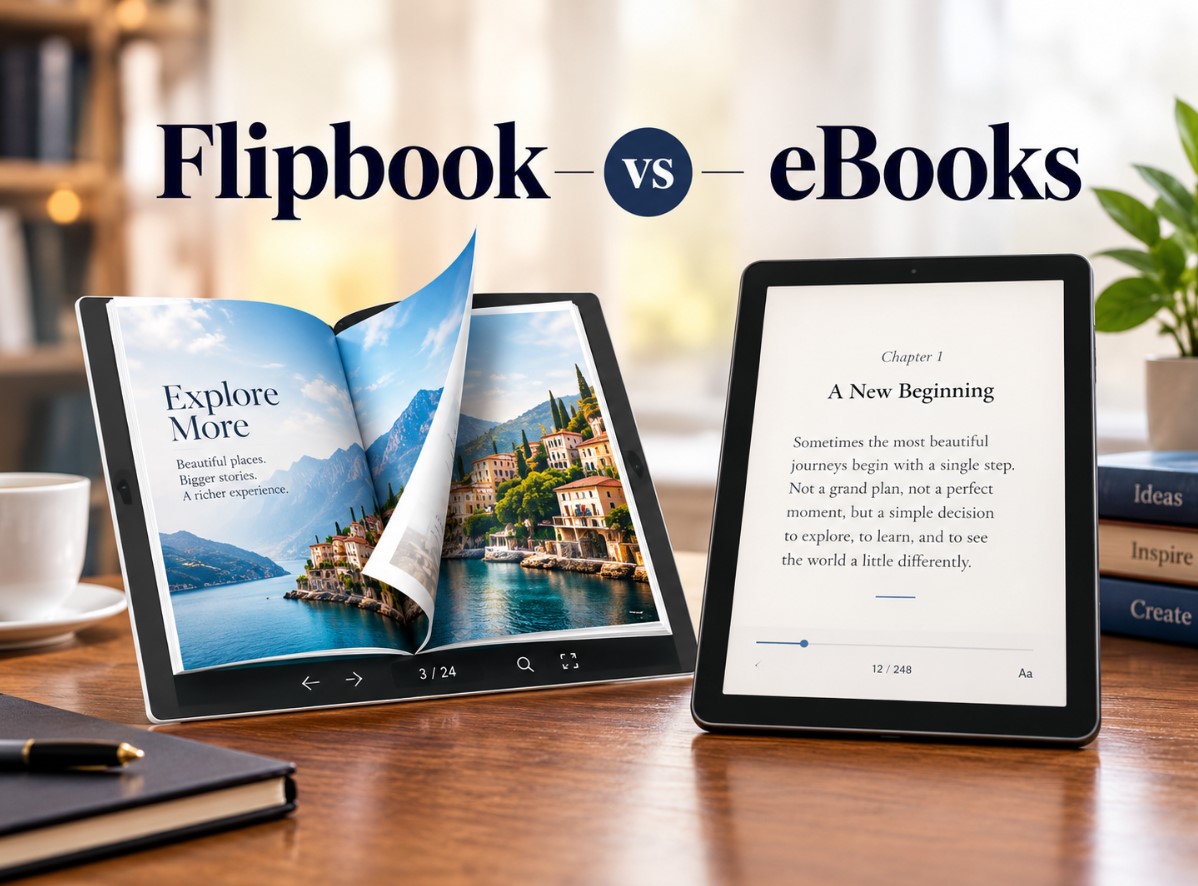
A flipbook is a digital replica of a page-based publication, with a fixed design and an animated page turn. An ebook is a flexible, reflowable text file that adapts to whatever device or font size the reader prefers.
Everything else, from media support to distribution to accessibility, follows from that split between fixed and fluid.
Fixed layout. A web-based replica of a designed page, usually with animated page turns, zoom, links, and other interactive elements.
Fluid layout. A downloadable reading file, typically EPUB, that can reflow around the reader's screen, font, and accessibility preferences.
A Quick Look Back: Where Each Format Came From
The word "flipbook" predates computers by well over a century. In 1868, English printer John Barnes Linnett patented the "kineograph," a handheld booklet of sequential images that created the illusion of motion when thumbed rapidly. Digital flipbooks borrow that tactile metaphor, the satisfying turn of a page, and apply it to modern publishing.
Ebooks have a different lineage. In 1971, Michael Hart began Project Gutenberg by typing the Declaration of Independence into a computer, often cited as the first ebook. The format matured slowly through the 1990s and 2000s, then went mainstream when dedicated e-ink devices arrived.
Sony's Librie appeared in 2004, and

EPUB standard emerged from the International Digital Publishing Forum and is now maintained under the W3C umbrella. It became the industry's open, non-proprietary answer to locked-down formats.
Flipbooks took off in the early 2000s, largely on Adobe Flash, which could render slick page-turn animations in a browser. When Flash reached end of life on December 31, 2020, the flipbook industry rebuilt itself on HTML5, which is why modern flipbooks run in any browser with no plugin required.
How a Flipbook Works
A flipbook typically begins life as a PDF. Publishing software converts each page into an image or interactive layer, then wraps the pages in a viewer with page-turn animation, zoom, search, and sharing tools. The result is hosted online and accessed through a link or embedded in a website.
Because the pages are fixed, a flipbook preserves everything the designer intended: exact typography, precise image placement, bleeds, spreads, and layered graphics. A two-page magazine spread looks like a two-page spread. A fashion lookbook keeps its dramatic, edge-to-edge photography.
✨ Where flipbooks shine:
- Design fidelity. Nothing reflows, shifts, or breaks. What you designed is what the reader sees.
- Rich media. Most flipbook platforms let you embed video, audio, GIFs, slideshows, pop-up product cards, and clickable hotspots on top of the page.
- Shareability. A flipbook is just a URL. You can drop it in an email, embed it on a landing page, or send it as a text message with no app or download.
- Analytics. Many platforms report page-level data on views, time spent, drop-off points, and link clicks, which is valuable for marketing teams.
- Familiarity. The page-turn interaction feels intuitive, and it can make a corporate brochure feel less like a dry PDF.
⚠️ Where flipbooks struggle:
- Small screens. A fixed page designed for print can be hard to read on a phone. Readers pinch, zoom, and pan, which gets tiring in long documents.
- Long-form reading. Nobody wants to read a 400-page novel by zooming into a scaled-down page image.
- Offline access. Most flipbooks are cloud-hosted and need an internet connection unless the platform offers an offline app or download.
- Accessibility. Page-image-based flipbooks can be problematic for screen readers unless the platform supports a proper text layer and tagged structure.
How an Ebook Works
An ebook, most commonly an EPUB, is essentially a packaged bundle of web technologies. Under the hood, an EPUB is a zipped collection of XHTML, CSS, images, and metadata. That structure is what makes it reflowable: the reading app decides how to lay out the text based on the screen size, font choice, margins, and reading mode the reader has selected.
This flexibility is the ebook's superpower. Someone with poor eyesight can crank the font size to 30 points. A commuter can switch to night mode. A reader on a tiny phone and a reader on a 10-inch e-ink tablet both get a comfortable layout from the same file.
✨ Where ebooks shine:
- Reading comfort. Adjustable fonts, spacing, and themes make ebooks ideal for hours-long reading.
- Portability. A single e-reader can hold thousands of titles, and downloaded files work fully offline.
- Distribution. Ebooks plug into major retail channels such as
Apple Books,
Kobo, and
Google Play Books, so readers can discover, buy, and download them in familiar stores.
- Accessibility. The EPUB standard has strong accessibility provisions, including semantic structure, navigation, and compatibility with screen readers and text-to-speech. Regulations such as the European Accessibility Act, which began applying in June 2025, have put more attention on accessible ebooks.
- Small file size. Text-heavy ebooks are lightweight, often only a few megabytes.
⚠️ Where ebooks struggle:
- Complex layouts. Heavily designed pages with overlapping images, sidebars, and multi-column arrangements are difficult to reproduce in reflowable form.
- Limited interactivity. Basic EPUB2 is essentially text and static images. EPUB 3 supports audio, video, and scripting, but support varies widely by reading device. Kindle e-ink devices, for instance, are far more limited than a tablet app.
- Inconsistent rendering. Because the reading app controls presentation, your book may look slightly different on every device.
A Nuance Worth Knowing: Fixed-Layout Ebooks
The line between the two formats isn't perfectly clean. EPUB 3 and Kindle both support fixed-layout ebooks, which lock the page design in place the way a flipbook does. Children's picture books, comics, graphic novels, and illustrated cookbooks commonly use fixed layout so the artwork and text remain precisely positioned.
So an ebook isn't always reflowable, and a fixed-layout ebook shares some traits with a flipbook. The main distinction is delivery: a fixed-layout ebook is a downloadable file read in an app or e-reader, while a flipbook is generally a web-based experience you open through a link.
Side-by-Side Summary
| Feature | Flipbook | Ebook |
|---|---|---|
| Layout | Fixed, mirrors the printed page | Usually reflowable; fixed-layout is possible |
| Reading experience | Page-turn animation, zoom | Scrolling or swiping, adjustable text |
| Media support | High (video, audio, links, hotspots) | Limited, and dependent on the device |
| Typical file type | HTML5 web link, often built from a PDF | EPUB, KFX, or PDF |
| Best for | Magazines, catalogs, brochures, portfolios | Novels, nonfiction, textbooks, long-form guides |
| Access | Browser-based, link sharing | E-reader or app, offline-friendly |
| Analytics | Often detailed, page-level | Limited, mostly retailer sales data |
Choosing the Right Format: A Practical Framework
Start with the content, then work outward to the audience.
Best aligned with fixed design, rich media, sharing, and engagement analytics.
Best aligned with reflowable text, reading comfort, portability, and accessibility.
Common Mistakes to Avoid
- Uploading a PDF and calling it an ebook. A raw PDF is a fixed-layout format, not a proper reflowable ebook. It reads poorly on small screens and won't offer adjustable fonts.
- Using a flipbook for a novel. The page-turn effect is charming for about ten seconds. After that, readers want comfort and portability.
- Ignoring accessibility. Whichever format you pick, include alt text, logical reading order, and proper headings.
- Skipping metadata. For ebooks especially, clean metadata (title, author, description, categories, keywords) drives discoverability in retail stores.
- Neglecting testing. Preview your file on multiple devices and reading apps before publishing.
The Bottom Line
Flipbooks and ebooks aren't competitors so much as tools for different jobs. If your priority is visual impact, rich media, and easy web sharing, the flipbook is a natural fit. If your priority is comfortable reading, broad retail distribution, and flexibility across devices, the ebook is the stronger choice. The best digital publishers understand the strengths of each and sometimes use both.
Need Help Bringing Your Book to Life?
Choosing a format is only the first step. Formatting, cover design, metadata, distribution, and launch strategy all affect how your book performs. If you're an author looking for professional guidance, visit Author Publishing Experts to explore how their team, including Dan Wasseman, Luke Leslie, and Mellisa Green, can support your publishing journey.
Contributor
I’m Luke Leslie, a Senior Business Consultant at Author Publishing Experts. I help authors navigate the publishing industry and turn their ideas into successful books and brands. I’m passionate about building strong author relationships and creating meaningful publishing opportunities.
View all articles →More from Author




The Daily Brief
Get the day's most important stories, handpicked by our editors, delivered to your inbox every morning.
No spam. Unsubscribe anytime.