

The Western Myth of Russian Greatness

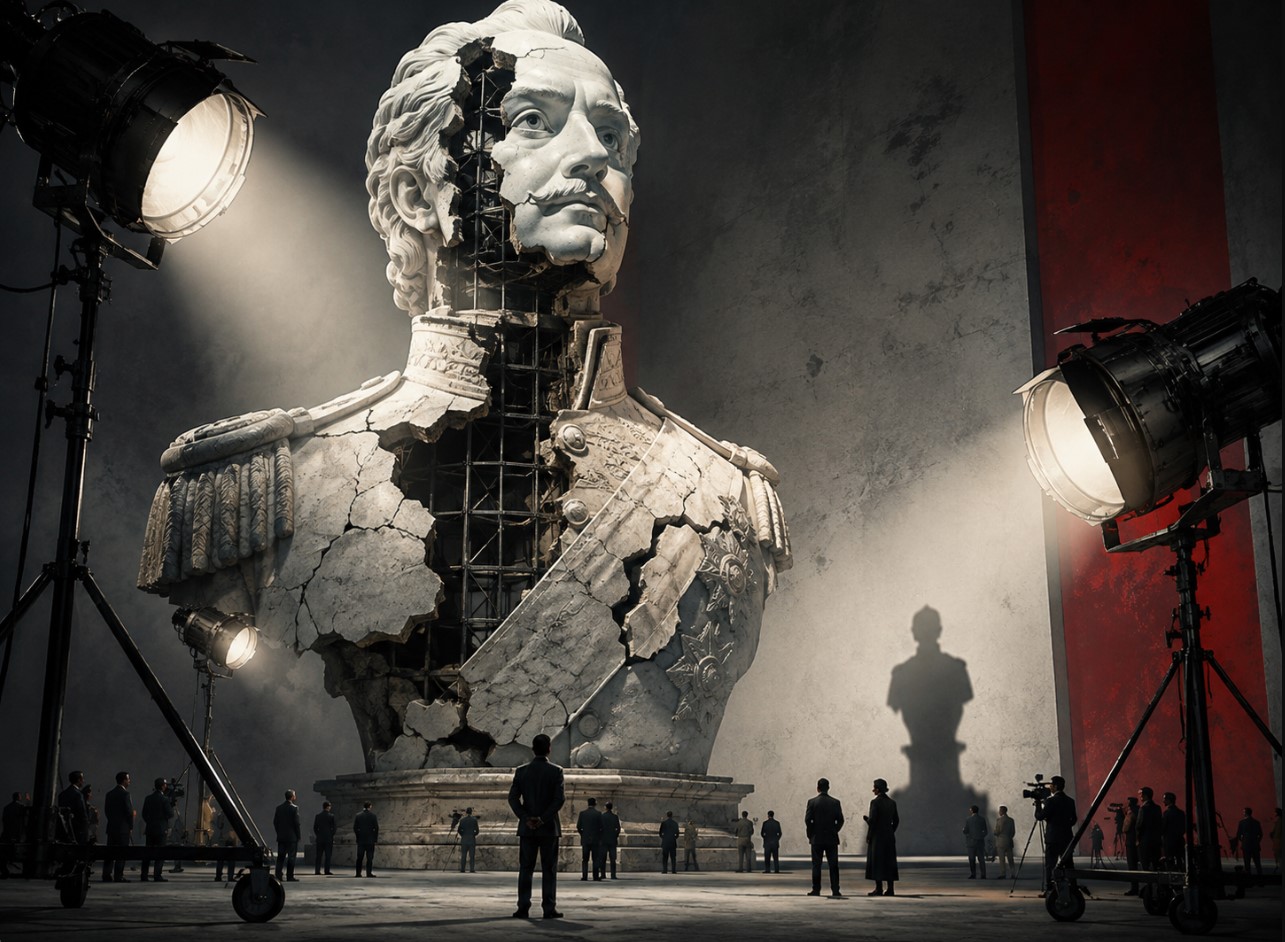
At a glance
From Cold War propaganda to modern geopolitics; how the West created a Russian giant that never quite existed.
If Hollywood had written the Cold War, the villain would have been six feet five, dressed in fur, speaking flawless English with a mysterious accent, and carrying nuclear launch codes in one pocket and a bottle of vodka in the other.
Reality has always been considerably less cinematic.
The myth of Russian greatness is one of the most successful public relations campaigns ever created, although much of it wasn't even designed by Russia itself. Ironically, many of its greatest marketers were Western politicians, intelligence agencies, filmmakers, journalists, and defense contractors. A terrifying opponent justifies larger military budgets. An omnipotent rival keeps alliances together. Nothing gets a legislature to approve another hundred billion dollars quite like convincing taxpayers that Ivan is lurking behind every Wi-Fi router.
The Soviet Shadow
To understand modern perceptions of Russia, one must separate the Soviet Union from the Russian Federation.
The Soviet Union was a global superpower. It stretched across eleven time zones, controlled half of Europe through satellite states, fielded millions of soldiers, competed head-to-head with the United States in space exploration, and possessed enough nuclear weapons to make geologists nervous.
The USSR consisted of fifteen republics, combining the resources, industries, scientists, engineers, and populations of nations ranging from Ukraine and Kazakhstan to the Baltic states and the Caucasus. Soviet scientific achievements, industrial capacity, and military production were multinational enterprises.
When the Soviet Union dissolved in 1991, much of that infrastructure disappeared overnight.
Russia retained the largest share, but it was no longer commanding an empire. It was attempting to rebuild a country while surviving one of the greatest economic collapses in modern history.
Yet many Western observers continued speaking about Russia as though the Soviet Union had merely changed its business cards.
A Giant With Clay Feet
Russia remains geographically enormous.
It is the largest country on Earth.
Size, however, has always been an unreliable measure of strength.
Canada is larger than the United States by land area. Nobody argues Ottawa secretly controls the planet.
| Metric | Russia | United States | China |
|---|---|---|---|
| Nominal GDP (2025) | ~$2.4T | ~$29.2T | ~$18.5T |
| GDP (PPP) | ~$5.2T | ~$29.2T | ~$35.6T |
| Exports | Oil, gas, minerals | Tech, services, machinery | Manufacturing, electronics |
| Economic diversification | Low | High | Moderate-High |
Its exports remain heavily dependent on oil, natural gas, minerals, fertilizers, and raw materials.
That is not necessarily weakness. Resource-rich nations can become extraordinarily wealthy.
The challenge emerges when commodities become the backbone rather than one pillar of economic strength.
- Oil prices fluctuate
- Sanctions accumulate
- Technology imports become restricted
- Diversification becomes difficult
One cannot simply replace semiconductor manufacturing by drilling another oil well.
Military Reputation Versus Battlefield Reality
For decades, the Russian military carried an aura bordering on mythology.
Hypersonic missiles
Elite commandos
Cyber warriors A machine operating with Swiss precision
Communication problems
Outdated equipment
Corruption in procurement Poor coordination & determined resistance
The world witnessed logistics failures, communication problems, outdated equipment, corruption within procurement systems, poor coordination, and unexpectedly determined resistance.
None of this means Russia is militarily weak.
It remains one of the world's largest nuclear powers and retains formidable missile capabilities, air defenses, and strategic depth.
But conventional warfare revealed something historians have observed repeatedly.
- Numbers matter
- Preparation matters
- Leadership matters
- Maintenance matters
Buying fifty thousand trucks means very little if thirty thousand are waiting for spare parts.
"PowerPoint has never lost a war. Reality remains undefeated."
The Intelligence Mystique
Few countries possess intelligence agencies surrounded by as much mythology as Russia.
From the days of the KGB to modern intelligence services, Western popular culture has portrayed Russian operatives almost as supernatural beings.
Master hackers
Sleeper agents
Double agents Triple agents pretending to be double agents pretending to be accountants
Embarrassing failures
Operational blunders
Bureaucratic chaos Competence exists. Omnipotence does not.
Some operations have indeed demonstrated remarkable sophistication. Others have looked astonishingly amateurish. History reminds us that intelligence agencies everywhere experience spectacular successes and embarrassing failures.
- The CIA missed the collapse of the Soviet Union.
- British intelligence has endured notorious blunders.
- American agencies failed to prevent September 11.
Russian services have likewise experienced operational failures that rarely become blockbuster movies.
Fear Is Profitable
Perhaps the greatest beneficiary of exaggerated Russian greatness has not been Moscow.
It has been everyone else.
- Defense industries receive larger contracts
- Political leaders justify difficult decisions
- Television networks enjoy higher ratings
- Think tanks publish reports with dramatic titles
- Consultants appear on cable news pointing at maps covered in arrows
Culture Is Not the Kremlin
Critiquing exaggerated perceptions of Russian power should never become an attack on Russian civilization itself.
Russia has produced extraordinary contributions to literature, music, mathematics, engineering, and science.
| Field | Contributors | Legacy |
|---|---|---|
| Literature | Tolstoy, Dostoevsky, Chekhov | Shaping world literature |
| Music | Tchaikovsky, Rachmaninoff, Stravinsky | Concert halls across the globe |
| Science & Math | Mendeleev, Pavlov, Landau | Lasting contributions to humanity |
Governments and cultures should never be confused. Political leadership changes. Civilizations endure.
The Mirror Effect
The Western myth of Russian greatness ultimately reveals as much about the West as it does about Russia.
Societies often exaggerate rivals to explain uncertainty.
- Economic anxiety becomes foreign competition
- Political dysfunction becomes outside interference
- Technological change becomes espionage
It is psychologically comforting to believe a brilliant adversary engineered our problems.
The alternative is considerably less flattering.
- Sometimes bureaucracies are simply inefficient.
- Sometimes politicians make poor decisions.
- Sometimes institutions decay from neglect rather than sabotage.
Blaming an external mastermind is far more satisfying than admitting ordinary incompetence.
The Real Lesson
Russia deserves to be taken seriously.
It possesses nuclear weapons, immense natural resources, sophisticated military technologies, and significant geopolitical influence.
It is neither a paper tiger nor an unstoppable empire.
The greatest mistake is to swing between extremes.
History rewards those who avoid both.
Every generation invents giants because giants make history feel simpler. Heroes become larger than life. Villains become omnipotent. Reality, meanwhile, quietly continues its work, stubbornly refusing to fit inside either story.
In the end, nations are not comic book characters. They are sprawling collections of people, institutions, ambitions, successes, failures, contradictions, and occasional bureaucrats who still cannot locate the correct spreadsheet.
That final detail, more than any spy novel ever written, may be the most universal truth of all.
Sources: Historical analysis, economic data, military assessments, and cultural criticism
More from Op-Ed




The Daily Brief
Get the day's most important stories, handpicked by our editors, delivered to your inbox every morning.
No spam. Unsubscribe anytime.