

How to Talk to Children About Breast Cancer: Helping Families Through Difficult Conversations

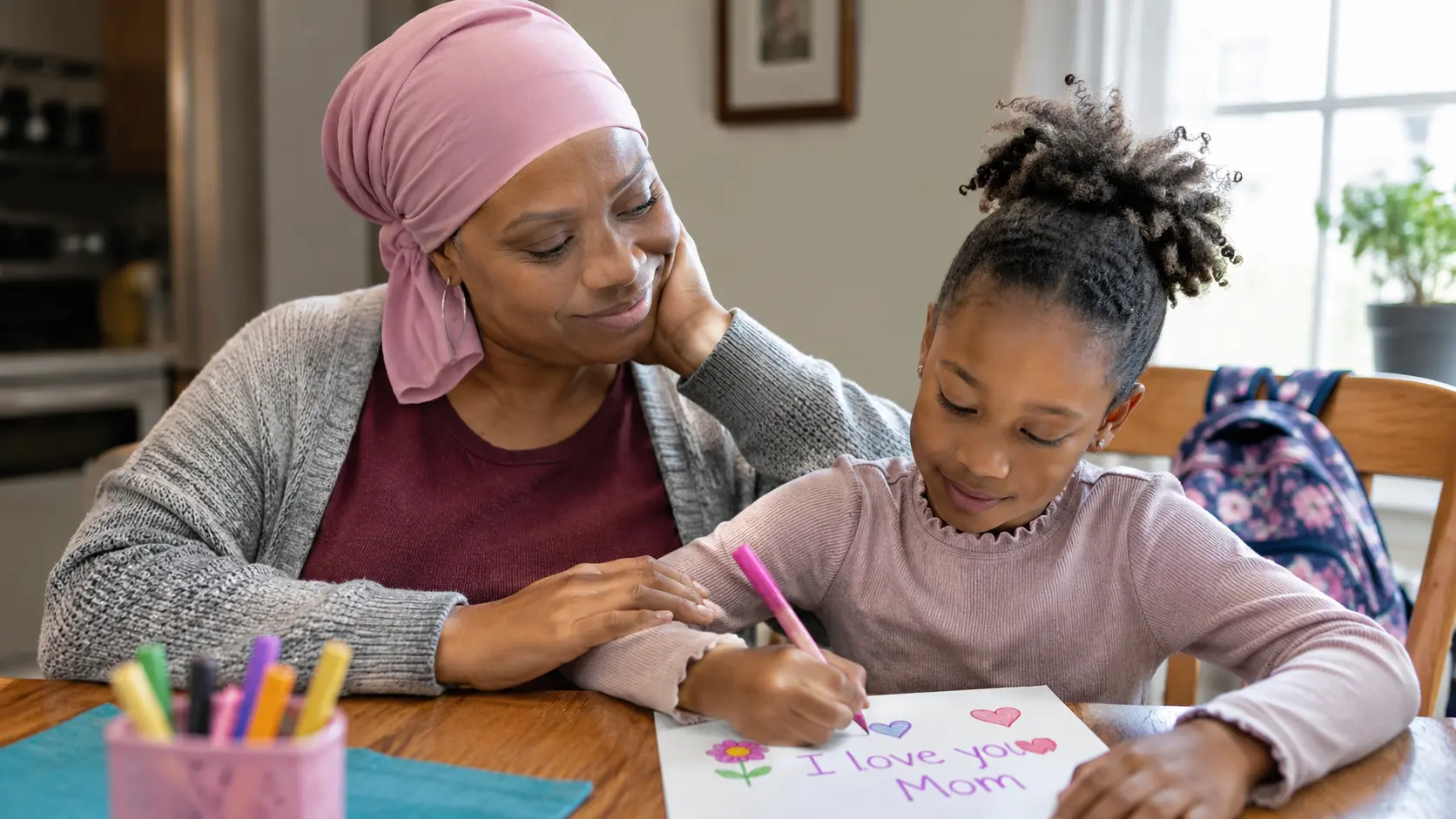
At a glance
Telling your kids you have breast cancer is terrifying, especially when you’re still trying to wrap your head around it yourself. Inspired by survivor and author Grace Clark’s own experience as a mom, this piece shares honest, gentle ways to answer tough questions about treatment and hair loss, and reminds you that you don't have to carry it all alone.
A breast cancer diagnosis changes more than a person's medical routine. It can change the atmosphere at home, interrupt familiar family activities, and leave children wondering why their mother seems worried, tired, or different.
For parents, one of the hardest parts may be finding the words to explain what is happening.
How do you tell a five-year-old that Mommy has cancer? What should you say when your child notices your hair falling out? How much information is appropriate, and how can you offer reassurance when you're still trying to process the diagnosis yourself?
Learning **how to talk to children about breast cancer** isn't about finding one perfect explanation. It's about making room for questions, giving honest answers that children can understand, and keeping communication open as treatment progresses.
Breast cancer survivor, author, and advocate Grace Clark understands this challenge personally. Her experience explaining her own diagnosis to her children inspired her to write books that help families approach these conversations with greater confidence and compassion.
Why Talking to Children About Breast Cancer Can Be So Difficult
Children notice changes in their parents, even when adults try to protect them from worrying.
They may recognize that something is wrong before anyone explains the situation. A parent might be attending more medical appointments, resting frequently, or experiencing visible changes from treatment.
Without an explanation, children may struggle to understand what they're seeing.
Some become quiet. Others ask questions repeatedly. Younger children may express their worries through changes in behavior rather than words.
Parents face a difficult balance. They want their children to understand the situation without frightening them unnecessarily.
The conversation also comes at a time when parents may be dealing with their own fear, exhaustion, and uncertainty.
For Grace Clark, who was diagnosed with breast cancer at age 39, explaining the illness to her children was among the most emotionally demanding parts of the experience. She had to help them understand a diagnosis she was still learning to navigate herself.
That experience eventually shaped her approach to writing for children.
Explaining Breast Cancer in Words Children Understand
Medical terms can be confusing even for adults. Words such as chemotherapy, oncologist, tumor, and surgery may be entirely unfamiliar to a young child.
A useful starting point is to explain the situation in small, understandable pieces rather than trying to cover every detail at once.
Children generally need an explanation that fits their age, along with opportunities to ask questions afterward.
Start With What Your Child Already Knows
Before explaining the diagnosis, ask your child what they've noticed.
They may have seen you visiting a doctor, heard conversations about treatment, or noticed that family members seem concerned.
Their answers can help you understand which parts of the situation need clarification.
You might begin by explaining that doctors have found cancer in your breast and are planning treatment to help you.
They don't have to introduce every medical detail immediately.
What matters is being truthful and making it clear that your child can return with more questions.
Use Familiar Comparisons Without Giving False Reassurance
Young children often understand unfamiliar ideas through comparisons with things they already know.
Grace Clark uses this approach in her children's book *Mommy, Where Is Your Hair?*
The story follows Sheree, a kindergartener whose mother, Grace, has been diagnosed with breast cancer.
When Sheree asks what a lump is, her mother compares it to a small, hard bead. She then explains, in child-friendly language, how abnormal cells can form a tumor.
The conversation introduces medical terms gradually, giving Sheree and her older brother, Jay, time to process what they're hearing.
This approach makes an unfamiliar subject easier to discuss without pretending that the illness is simple.
Parents should also avoid promises they cannot guarantee. Instead of assuring children that nothing bad will happen, they can explain what the doctors are doing, what is known about the treatment plan, and who will care for them during any changes at home.
Helping Children Understand Hair Loss During Cancer Treatment
Hair loss can be one of the most noticeable treatment-related changes for children.
A child who has always known their mother with a particular hairstyle may feel confused or frightened when that appearance changes.
They might wonder whether the hair loss means the illness is getting worse.
Some children may not want to talk about it at all.
In *Mommy, Where Is Your Hair?*, Sheree struggles with seeing her mother lose her hair during treatment.
Her mother explains that chemotherapy can make her feel unwell and cause her hair to fall out.
Later, Sheree sees her mother wearing a scarf and reacts with the directness of a young child. She even compares her mother's changing appearance to a familiar family member.
Rather than treating these reactions as inappropriate, the story allows them to become part of the family's conversation.
Give Children Time to Adjust
A child may need to hear an explanation several times before accepting a visible change.
Parents can acknowledge that the change looks unfamiliar or feels upsetting.
It may also help to explain that hair loss is a possible side effect of certain cancer treatments, not something that happens to every person receiving treatment.
In Clark's story, the family eventually goes shopping for hats and scarves. Sheree, her brother, and their father help choose items for their mother.
This moment brings the children into an everyday family activity during a difficult period.
Participating in a small decision can help children feel included without placing responsibility for their parent's recovery on them.
When Children Want to Help a Parent With Cancer
Children often respond to a parent's illness by asking what they can do.
They may want to bring a glass of water, sit beside their parent, help with a household task, or simply spend more time together.
These gestures can be meaningful, especially when the child's role remains appropriate for their age.
Clark explores family participation and support in another children's book, *Mommy, We Can Help.*
The book was developed from her experience of helping her children understand the emotional and physical changes associated with cancer treatment.
Its central subject is a concern many families share: how children can respond when someone they love is unwell.
Small Acts of Help Are Enough
Children don't need to become caregivers to make a difference.
Parents can encourage simple, manageable activities, such as bringing a favorite blanket, drawing a picture, reading together, or helping with an ordinary task.
It also helps to remind children that they are not responsible for making the cancer disappear.
They can show love and support while continuing to enjoy school, friendships, play, and their usual routines.
Family members and trusted adults can help maintain that balance when a parent is receiving treatment.
Parents Need Support With Their Own Emotions, Too
Talking openly with children can be harder when parents are struggling to express their own feelings.
A breast cancer diagnosis can bring fear, sadness, anger, uncertainty, and questions about the future.
Some people find themselves trying to remain strong for everyone around them while privately feeling overwhelmed.
Grace Clark remembers experiencing isolation despite having supportive family members and friends.
During treatment, she became involved with The Witness Project of Connecticut, an organization supporting African American women affected by breast cancer.
Connecting with other survivors helped her feel understood and gave her a place to discuss experiences that were difficult to explain elsewhere.
Those connections later influenced her work in community education and patient advocacy.
Making Space for Difficult Feelings
Clark's Breast Cancer Survivor Workbook approaches emotional well-being in a practical way.
Rather than expecting patients to feel positive all the time, it includes opportunities to identify and write about emotions such as fear, disbelief, sadness, anger, loneliness, and loss of control.
The workbook encourages people to acknowledge their feelings rather than keep everything inside.
It also addresses parenting concerns, including helping children understand a diagnosis and treatment, recognizing how cancer may change family life, and deciding how much personal information to share.
These issues deserve attention alongside medical care.
When parents have a place to discuss their concerns, they may find it easier to approach conversations with their children.
Keeping Track of Treatment and Family Concerns
Cancer treatment can involve multiple appointments, unfamiliar medical language, and decisions that require careful discussion with healthcare professionals.
At the same time, parents may be trying to manage work responsibilities, school schedules, and the changing needs of their household.
Writing things down can help keep information organized.
Clark's *Breast Cancer Survivor Workbook*, subtitled *From One Survivor to Another*, provides structured sections for recording medical information, preparing questions, and reflecting on personal experiences.
Its topics include breast health, risk factors, diagnostic testing, treatment information, care-team contacts, emotional concerns, family history, and survivorship planning.
The workbook also gives patients room to record questions for their doctors and document follow-up recommendations.
One section specifically addresses parenting and children, acknowledging that a diagnosis can affect family relationships and the way parents communicate with their children.
These written resources are intended to support discussions with healthcare professionals, not replace individualized medical advice.
For families, having medical details organized can leave more room to focus on the conversations happening at home.
Finding Breast Cancer Support Beyond the Immediate Family
Not every concern can be resolved within the household.
Some patients need to speak with people who have personally experienced breast cancer, particularly when dealing with treatment decisions, long-term side effects, or feelings of isolation.
For African American women and people from underserved communities, finding support that reflects their experiences can be especially meaningful.
Grace Clark founded Covering My Sisters, Inc. in 2017 to create a supportive environment where women affected by breast cancer could connect, receive education, and share their experiences.
Although the organization began with a focus on African American women, it has expanded its support to include people of different backgrounds affected by the disease, including men.
Its activities include breast health education, survivor support groups, community outreach, and patient navigation.
Through the *Sisters Reaching Sisters* program, experienced survivors connect with newly diagnosed individuals through telephone conversations or in-person visits.
The organization's survivor navigators also help patients better understand their diagnosis, treatment-related concerns, and questions to discuss with their healthcare teams.
This kind of peer connection addresses something that medical appointments alone may not provide: the opportunity to speak openly with someone who has faced similar experiences.
About the Author: Grace Clark

Grace Clark is a breast cancer survivor, author, patient advocate, and the founder and CEO of Covering My Sisters, Inc.
Diagnosed with breast cancer at age 39, Clark experienced the challenges of treatment, multiple surgeries, recovery, and the lasting effects of cancer care. At the time of her supplied biography, she had been a survivor for 26 years.
Her experiences led her to advocate for improved breast health education, informed treatment decisions, and stronger support for patients and families.
In 2017, she founded Covering My Sisters, Inc., with a particular focus on reaching African American women and underserved communities affected by breast cancer.
Clark is the author of *Mommy, Where Is Your Hair?* and *Breast Cancer Survivor Workbook*, two children's books inspired by the challenges of explaining her diagnosis and treatment to her own children.
She also developed the *Breast Cancer Survivor Toolkit* and *Breast Cancer Survivor Workbook* to help individuals understand their care, organize medical information, and advocate for themselves.
Her advocacy work includes involvement with The Witness Project of Connecticut, Relay For Life, Making Strides Against Breast Cancer, and the National Breast Cancer Coalition. She has participated in Project LEAD®, Lobby Day, and the San Antonio Breast Cancer Symposium Advocacy Program.
She also serves as a Susan G. Komen Public Policy Advocate and breast cancer survivor spokesperson, working to bring patient and survivor concerns into conversations about healthcare policy.
The Conversation Doesn't Have to End After the Diagnosis
A child's questions about breast cancer rarely stop after the first family discussion.
They may return when treatment begins, when a parent spends time in the hospital, or when physical changes become noticeable.
A younger child might ask why Mommy is sleeping so much. An older child may want to know more about the diagnosis or how treatment works.
Some questions may come at unexpected moments, such as during dinner, on the way to school, or before bedtime.
Parents don't need to have every answer ready.
It's reasonable to say that a question is difficult, that more information is needed, or that the family will ask the medical team together.
Books like *Mommy, Where Is Your Hair?* and *Mommy, We Can Help* can give families a starting point when the right words are difficult to find.
They also remind parents that children are part of the family's experience, even when adults are doing their best to shield them from worry.
For Grace Clark, helping children understand breast cancer began with conversations she needed to have in her own home.
Those conversations became part of her writing because other parents face the same difficult questions.
Sometimes a child simply wants to know why Mommy looks different today.
Answering that question with patience, honesty, and love can create room for the next one.
More from Health & Wellness




The Daily Brief
Get the day's most important stories, handpicked by our editors, delivered to your inbox every morning.
No spam. Unsubscribe anytime.